Puerto Rico sells gas by the liter. The Department of Consumer Affairs, known as DACO, publishes each grade's lowest and highest pump prices.
See gas pricesThings to do in Puerto Rico › Driving in Puerto Rico
Driving in Puerto Rico
Drive right · Gas by the literUpdated November 27, 2026 Traffic law, DACO prices and Metropistas toll tables
You drive on the right in Puerto Rico with your valid U.S. license. Speed limits use miles per hour, and distance signs use kilometers. Gas is sold by the liter, and tolls are electronic.
What to know first
Driving in Puerto Rico: gas, tolls, rules and a car
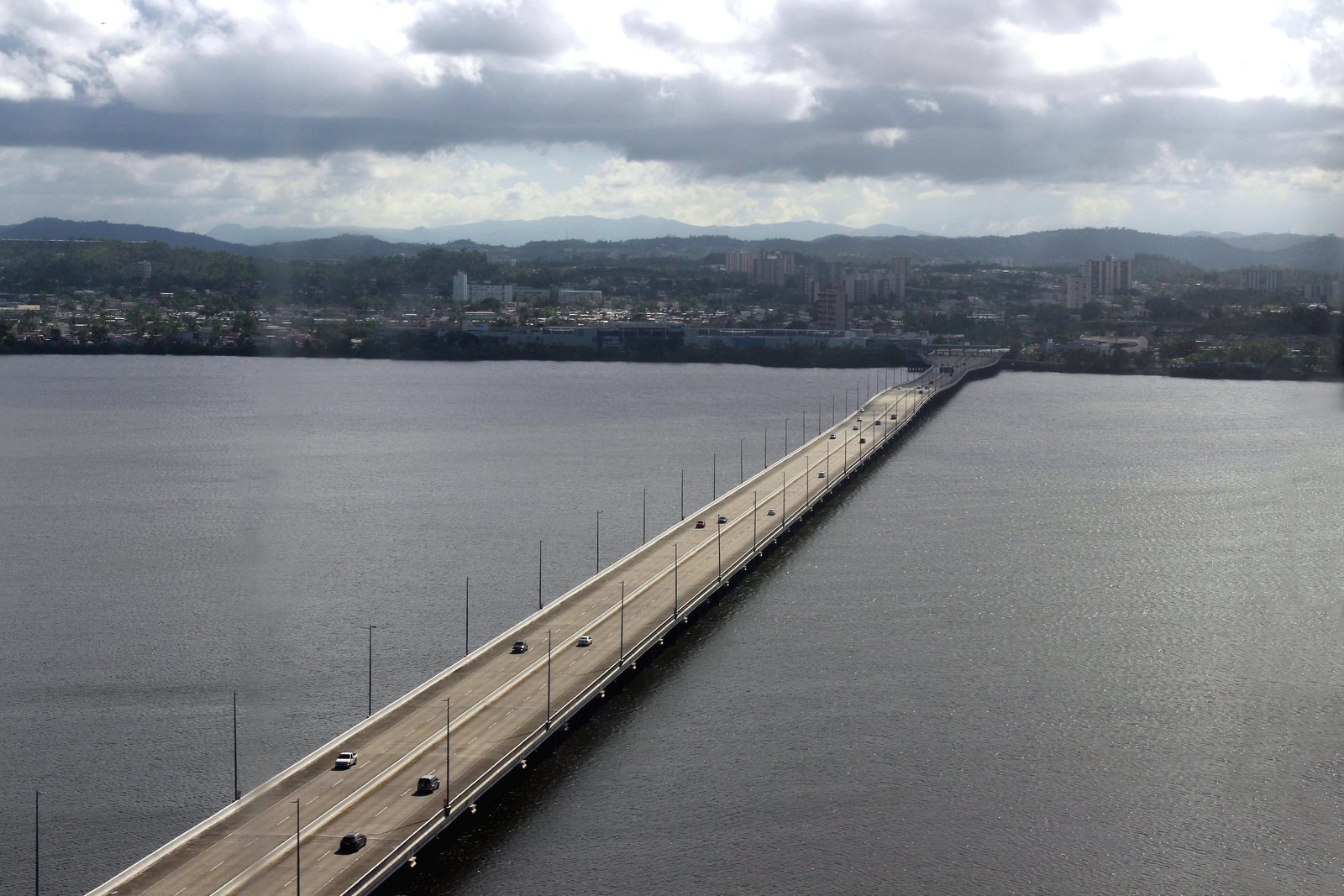
PR-22 and PR-52 use electronic tolls, along with the other roads in the toll table. The Teodoro Moscoso Bridge to San Juan Airport (SJU) costs $4.00 each way for ordinary cars.
Toll roads and ratesPuerto Rico uses Spanish road signs, including PARE for stop. Your speed limit is in miles per hour.
Road signs in EnglishA car suits trips beyond San Juan. The mapped route from San Juan Airport (SJU) to Ponce's Plaza Las Delicias covers 116.9 km or 72.7 miles by road.
See cars at SJU ↗Cars and prices open on the booking page of our car rental partner. You pay the same price there.
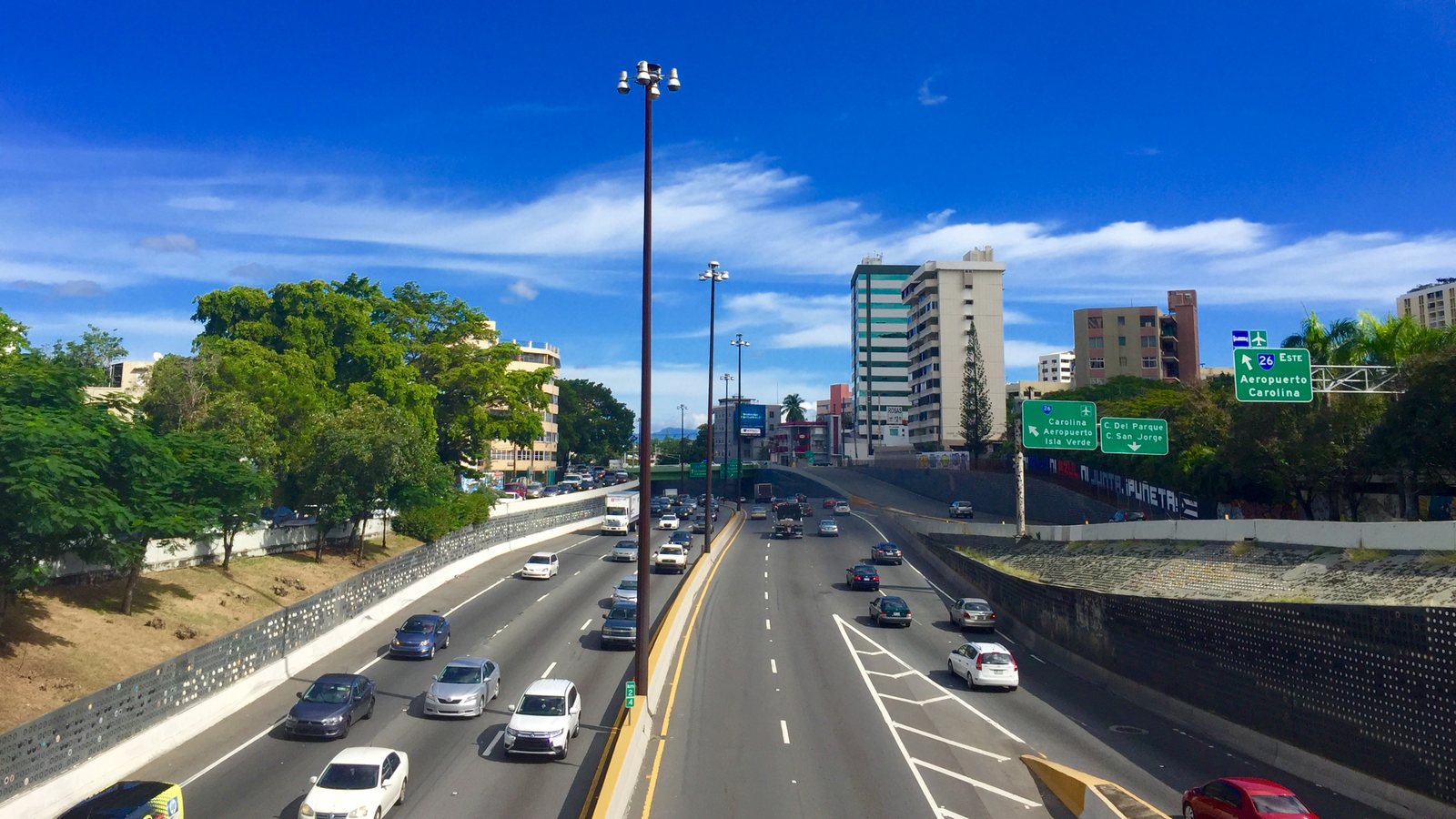
Compared with the U.S.
Is driving in Puerto Rico the same as in the United States
You drive on the right and read speeds in mph, just as in the U.S. states. Spanish signs and fuel sold by the liter aren't the same.
| Side of the road | the same | Puerto Rico keeps traffic on the right side of the road. You pass on the left when the road permits it. |
| Your U.S. license | valid | U.S. residents can drive in Puerto Rico with a valid state or territory license for 180 days after arrival. Carry your license when you drive. |
| Speed limits | miles per hour | Puerto Rico's default limits are 25 mph urban and 45 mph rural. Expressway limits reach 65 mph. Follow the posted limit. |
| Distances on signs | kilometers | Guide signs give distances in kilometers, including the distance to a town's center. Those numbers aren't speed limits. |
| Gas | by the liter | Gas is sold by the liter in Puerto Rico. To compare prices in dollars per U.S. gallon, multiply dollars per liter by 3.785. |
| Road signs | in Spanish | PARE means stop on Spanish road signs. CEDA EL PASO means yield, so you slow down and stop if needed. |
| Tolls | no cash | AutoExpreso is Puerto Rico's prepaid electronic toll system. Use an installed tag with enough funds before passing a toll point. |
Before you drive
- Your license Carry your valid driver's license whenever you drive. The car's registration permit must also stay in the vehicle.
- If you crash Stop safely and help anyone injured. If police haven't investigated at the scene, report a crash that injures someone else or damages their property. Notify the nearest police station immediately. The deadline is four hours.
- In an emergency 9-1-1 handles emergencies in Puerto Rico. Metropistas provides free roadside help around the clock on its toll roads at 787-705-8699.
Gas prices
Gas prices in Puerto Rico
Gas in Puerto Rico is sold by the liter. Regular gasoline ranged from 99.7 to 105.7 cents per liter at the pump on November 13, by the figures of the Department of Consumer Affairs. That converts to $3.77 to $4.00 per U.S. gallon.
| Grade | Lowest pump price | Highest pump price | In dollars per U.S. gallon |
|---|---|---|---|
| Regular | 99.7 cents per liter | 105.7 cents per liter | $3.77 to $4.00 |
| Premium | 113.7 cents per liter | 125.7 cents per liter | $4.30 to $4.76 |
| Diesel | 135.7 cents per liter | 142.7 cents per liter | $5.14 to $5.40 |
The catch: Multiply dollars per liter by 3.785 for dollars per U.S. gallon. If your price is in cents per liter, divide that result by 100. Prices vary between stations.
Lowest and highest pump prices published by Puerto Rico's Department of Consumer Affairs (DACO) on November 13, in cents per liter. Dollars per U.S. gallon are this site's conversion at 3.785 liters to the gallon, to two decimal places. Pump prices can change.
Tolls
Puerto Rico toll roads and toll rates
Puerto Rico charges electronic tolls on six numbered expressways and the Teodoro Moscoso Bridge. These are Class 1 rates at the main toll points. Your total depends on where you enter and exit.
| Toll road | Where it runs | Toll points and rates for cars |
|---|---|---|
| PR-22 | San Juan to Hatillo, the north coast | Buchanan $1.00, Toa Baja $1.00, Vega Alta $1.00, Manatí $1.40, Arecibo $1.40, Hatillo $1.00 |
| PR-52 | San Juan to Ponce by Caguas and Cayey | Montehiedra $0.50 northbound, Caguas Norte $1.05, Caguas Sur $0.75, Salinas $1.15, Juana Díaz $0.70, Ponce $1.00 |
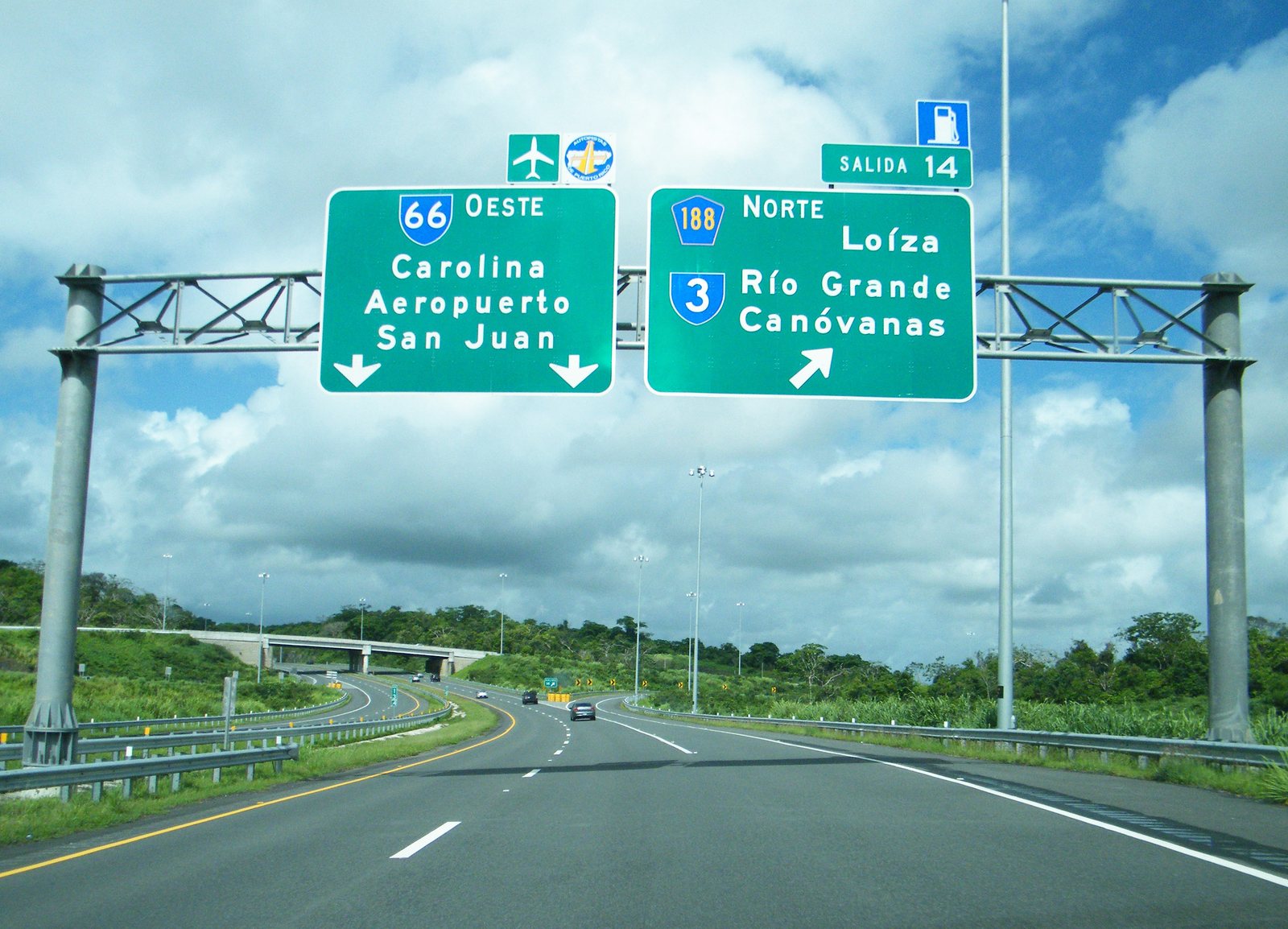
| PR-66 | Carolina to Río Grande, toward El Yunque | Carolina $1.70, Río Grande $1.10 |
| PR-53 | the east and south-east coast | Ceiba, Humacao Norte, Humacao Sur and Húcar $0.75 each, Guayama $0.70 |
| PR-20 | Guaynabo | $0.60 |
| PR-5 | Bayamón | $0.55 |
| Teodoro Moscoso Bridge | San Juan to San Juan Airport (SJU) over the San José Lagoon | $4.00 |
The catch: You can't pay an individual toll in cash. Rental programs either add fees to tolls or include tolls in a daily price. The car rental page compares the terms.
Rates for ordinary cars (Class 1) at the main toll points, from the pages of the toll operator, Metropistas. Rental toll programs have their own terms: some add a fee to the tolls, and unlimited plans include tolls in a daily price.
Road signs
Road signs in Puerto Rico: Spanish to English
Puerto Rico uses Spanish road signs, so NO ESTACIONE tells you not to park. Sign shapes and colors follow the U.S. system.
| On the sign | In English | What it tells you |
|---|---|---|
| PARE | stop | a red octagon: come to a complete stop |
| CEDA EL PASO | yield | an inverted white triangle with a red border: slow down and stop if you must |
| NO ENTRE | do not enter | no entry from this direction |
| NO ESTACIONE | no parking | in the direction of the arrow |
| NO VIRE A LA IZQUIERDA / A LA DERECHA | no left turn / no right turn | a prohibition sign |
| SIGA POR SU DERECHA | keep right | stay to the right |
| TRÁNSITO | traffic | shows the direction of traffic |
| SOLO | only | a lane reserved for the movement shown |
| RESBALA MOJADO | slippery when wet | a diamond-shaped warning sign |
| CUESTA | hill | a diamond-shaped warning sign |
| ROTONDA | roundabout | a diamond-shaped warning sign |
| CONFLUENCIA | merge | a diamond-shaped warning sign |
| ZONA ESCOLAR | school zone | start slowing down |
| CRUCE DE PEATONES | pedestrian crossing | yield to people crossing |
The catch: Your speed-limit signs use miles per hour. Distance signs use kilometers, so you shouldn't read both sets of numbers as miles.
Legends and meanings from Puerto Rico's official driver's manual and its traffic law.
By road
Driving around and across Puerto Rico: road distances
The mapped San Juan loop covers 455.3 km or 282.9 miles by road. It returns through Fajardo and Mayagüez. San Juan to Ponce crosses north to south over 118.2 km or 73.4 miles by road.
| Route | Distance | Main roads | |
|---|---|---|---|
| Around the island: San Juan, Fajardo, Humacao, Guayama, Ponce, Mayagüez, Aguadilla, Arecibo, San Juan | 455.3 km | 282.9 miles | PR-2, PR-22, PR-53, PR-3, PR-52 |
| San Juan to Ponce, north to south | 118.2 km | 73.4 miles | PR-52 |
| San Juan to Mayagüez by the north coast | 159.3 km | 99 miles | PR-22, PR-2 |
| Fajardo to Mayagüez, east to west by the south coast | 224.5 km | 139.5 miles | PR-2, PR-53, PR-52, PR-3 |
| San Juan to Fajardo | 59.9 km | 37.2 miles | PR-3, PR-66, PR-26 |
| San Juan to Aguadilla | 132.3 km | 82.2 miles | PR-22, PR-2 |
| Ponce to Mayagüez | 74.6 km | 46.4 miles | PR-2 |
The catch: These are road distances, and San Juan traffic shapes your journey. This site doesn't print drive times.
Road distances measured along one route on OpenStreetMap roads from town square to town square. Another route changes the distance. Drive times change with traffic and are left out.
From the airport
Driving distances from San Juan Airport (SJU)
San Juan Airport (SJU) to Plaza Colón in Old San Juan is 13.0 km or 8.1 miles by road. San Juan Airport (SJU) to Ceiba ferry terminal is 65.9 km or 40.9 miles by road.
| From San Juan Airport (SJU) to | Distance | Main roads | Toll roads on the route | |
|---|---|---|---|---|
| Old San Juan, Plaza Colón | 13 km | 8.1 miles | PR-26, PR-1, PR-25 | no toll road |
| El Yunque, El Portal visitor center | 39.9 km | 24.8 miles | PR-66, PR-26, PR-3 | PR-66 |
| Ceiba ferry terminal (Vieques, Culebra) | 65.9 km | 40.9 miles | PR-3, PR-66, PR-26 | PR-66, PR-53 |
| Cueva Ventana, Arecibo | 93.2 km | 57.9 miles | PR-22, PR-10 | PR-22 |
| Ponce, Plaza Las Delicias | 116.9 km | 72.7 miles | PR-52 | PR-52 |
| Crash Boat Beach, Aguadilla | 137.9 km | 85.7 miles | PR-22, PR-2 | PR-22 |
| Rincón, town center | 153.6 km | 95.4 miles | PR-22, PR-2 | PR-22 |
| La Parguera, Lajas | 173.2 km | 107.6 miles | PR-52, PR-2, PR-116 | PR-52 |
Means: The mapped route to Old San Juan avoids toll roads. The El Yunque route uses PR-66, and the Ponce route uses PR-52. You can't buy a ferry vehicle ticket for a rental car.
Road distances measured on OpenStreetMap roads from the rental counters at San Juan Airport (SJU) to each place. A shuttle office or another route changes the distance. Drive times change with traffic and are left out.
Map
Puerto Rico driving map: the loop around the island
San Juan, Plaza Colón: 18.4662° N, 66.1121° W Directions in Google Maps Apple Maps
The main roads
- PR-22 and PR-2, north and west PR-22 is the toll expressway from San Juan to Hatillo. PR-2 follows the north coast and continues west beyond Hatillo. PR-2 isn't tolled.
- PR-52, San Juan to Ponce PR-52 is the toll expressway from San Juan to Ponce through Caguas and Cayey. Your north-to-south route crosses the mountains before reaching the south coast.
- PR-26, PR-66, PR-3 and PR-53, the east PR-26 isn't tolled from San Juan to Carolina, and PR-66 charges tolls on to Río Grande. PR-3 follows the east coast and isn't tolled. Tolled PR-53 has gaps between its coastal segments.
- PR-2, the south and west coast PR-2 connects Aguadilla with Mayagüez and continues around the coast to Ponce. PR-2 isn't tolled. Ponce to Mayagüez is 74.6 km or 46.4 miles by road.
Step by step
How to pay tolls in Puerto Rico with a rental car
Your rental company's toll program handles the car's electronic toll charges.
- 1
Know which roads are tolled
PR-22 and PR-52 are toll roads. PR-66 and PR-53 also charge tolls. PR-5 and PR-20 complete the numbered toll-road list. The Teodoro Moscoso Bridge charges separately for each crossing. Match your route to those roads before you choose a rental toll program.
- 2
Read the toll program of your rental company
Each rental company sets its own toll program and fees. Some programs charge per day, and others charge once per rental. The car rental page compares those terms. Read your program before you accept the car. Unlimited-toll plans bundle tolls into their daily fee.
- 3
Drive through: there is no cash lane
AutoExpreso takes prepaid electronic payments, and no toll point takes cash. Cash in an R lane tops up an account. You don't pay an individual toll there. The law fines use of an AutoExpreso lane without a tag $100. Your rental company handles its own tag and account.
- 4
Use the express lanes only with funds
PR-22 and PR-52 express lanes need an active AutoExpreso account with funds. Their published weekday schedule runs toward San Juan in the morning and away in the afternoon. PR-22 runs between Dorado and Bayamón. PR-52 runs between Caguas and San Juan. A green arrow means the lane is open. A red X means it is closed. Follow the lane signals because operating directions can change.
- 5
Check the tolls on your bill
Rental toll charges can arrive after you return the car. Keep your agreement and compare the bill with your toll program. Take missing or disputed rental toll charges to your rental company.
The catch: Rental toll charges can arrive after your return. Some plans charge tolls plus a fee. Unlimited plans include tolls in their daily price.
How much are tolls in Puerto Rico
- Puerto Rico tolls are charged by the toll points you pass. An ordinary car pays $4.00 each way on the Teodoro Moscoso Bridge. PR-66 charges $1.70 at Carolina and $1.10 at Río Grande. Rental-program charges depend on your plan.
Cars and prices open on the booking page of our car rental partner. You pay the same price there.
Know before you drive
Puerto Rico driving rules: speed, red lights, phones, alcohol and children
Speed limits
Puerto Rico's default limits are 25 mph urban and 45 mph rural. Expressway limits reach 65 mph. Follow the posted limit. School zones allow 15 mph urban and 25 mph rural. School limits apply from 6 a.m. to 7 p.m. on school days unless signs specify otherwise. The usual speeding fine is $100 plus $10 per mph over. In marked school zones, speeding costs $200 plus $10 per mph over.
Red lights and stop signs
You can turn right on a red light from the far-right lane unless signs prohibit it. Stop fully and yield to pedestrians and vehicles. Don't turn against a red arrow. Left on red is allowed from a one-way street into another one-way street. Use the far-left lane and stop before yielding. From midnight to 5 a.m., you may stop at an ordinary red light and proceed cautiously. An illegal red-light crossing costs $300 if you stopped first. Crossing illegally without stopping costs $500. Permitted turns still require a full stop. At a failed signal, obey any remaining signs. If vehicles arrive together without priority signs, yield to traffic on your right. PARE signs require a full stop before you yield to cross traffic.
Phones and alcohol
Use hands-free calling while you drive. Prohibited phone use, including texting, carries a $100 fine. For private-car drivers aged 21 or older, driving at 0.08% blood alcohol or more is illegal. The threshold is 0.02% for ages 18 to 20. Drivers under 18 may not drive with alcohol in their blood. A first drunk-driving conviction carries a $500 fine plus $50 per 0.01% over the limit. It also requires a course and brings a license suspension of up to 30 days. Open containers above 0.5% alcohol in a moving car's passenger area carry a $200 fine.
Seat belts and child seats
You and your passengers must use seat belts, with a $100 fine per unbelted person. Children under 8 need an unexpired seat suited to their age. Children under 2 need rear-facing seats. The law specifies forward-facing seats for children older than 2 through age 4. For ages 4 to 8, the law allows a booster or convertible seat. This applies below 4 feet 9 inches and at weights up to 65 pounds. A child-seat violation carries a $500 fine. Children under 12 must ride in back. If your car has only front seats, you must deactivate the airbags. The required child seat still applies.
Parking and yellow curbs
A yellow curb bans stopping and parking, with a $50 fine. You can't park within 5 meters of a corner or fire hydrant. Park parallel within 12 inches of the curb. The law's fine for breaking the parallel-parking rule is $50. Police removal for illegal parking costs $55 for towing plus $55 for storage. After 48 hours, the extra charge is $15 for each day. That extra charge is capped at $400.
After a crash
Stop safely and help anyone injured. Move a drivable car out of traffic when you can do so safely. Exchange your name and address with the other driver. Give the other driver your vehicle registration number. Show your license and insurance details on request. Stay at the scene until you have met these duties. If police haven't investigated at the scene, report a crash that injures someone else or damages their property. Notify the nearest police station immediately. The deadline is four hours. ACAA, the public accident agency, provides medical cover for people injured in a crash.
The scenic route
Ruta Panorámica: the scenic drive across Puerto Rico
The Ruta Panorámica is a scenic route along Puerto Rico's central mountains. The Ruta Panorámica links Maunabo to Mayagüez across 21 municipalities over 266 kilometers of roads.
The route
PR-143 forms the backbone of the Ruta Panorámica. Sections of PR-105 and PR-182 also form part of it. Brown signs mark the scenic route. You follow several highway numbers across the mountains. The highway authority is responsible for maintaining the route. Check its traffic map before you set out.
Before you go
The transport department's long-range plan includes an overview map of the Ruta Panorámica. Landslides can affect mountain roads. Check the highway authority's traffic map before you set out. Don't drive onto a flooded road.
Without driving
Tours with pickup instead of driving
El Yunque rainforest tours
14 tours · from $25
The El Yunque list has fourteen tours with different transport options. Casa Venturas includes pickup within its listed areas. Some tours require your own car.
Caves, rivers and waterfalls 14 tours · from $79The caves list has fourteen tours, including Local Tourist Puerto Rico's Cueva Ventana and waterfall trip. You can choose its pickup option from listed San Juan hotels.
Airport transfers 14 tours · from $11The airport transfers list has fourteen rides, including Transfers PR between San Juan Airport (SJU) and San Juan hotels. You can also book Prestige Luxury Transport for hotel pickup and a private airport transfer.
Good to know
People also ask
- How much is gas in Puerto Rico?
Gas in Puerto Rico is sold by the liter. Regular gasoline ranged from 99.7 to 105.7 cents per liter at the pump on November 13, by the figures of the Department of Consumer Affairs. That converts to $3.77 to $4.00 per U.S. gallon. For dollars per U.S. gallon, multiply cents per liter by 3.785 and divide by 100. Your station may charge a different price.
- Can you drive in Puerto Rico with a U.S. license?
U.S. residents can drive in Puerto Rico with a valid state or territory license for 180 days after arrival. You don't need an international driving permit. Carry your license whenever you drive. Your rental company may require other documents. The car rental page covers those requirements. Residents of foreign countries have a 90-day exemption when their license meets the law's recognition rules.
- What side of the road does Puerto Rico drive on?
Puerto Rico drives on the right. Pass on the left where allowed. Keep right when you're moving slower than traffic. You can't use the shoulder to bypass traffic. Driving on the shoulder carries a $500 fine. On a narrow hill where cars can't pass, downhill traffic yields to uphill traffic.
- What is the speed limit in Puerto Rico?
Puerto Rico's default speed limits are 25 mph urban and 45 mph rural. Expressway limits reach 65 mph. Follow the posted limit and slow down for hazards. Authorized urban roads with four or more lanes can allow 35 mph. Authorized rural stretches can allow 55 mph. School zones allow 15 mph urban and 25 mph rural. School limits apply from 6 a.m. to 7 p.m. on school days unless signs specify otherwise. A posted maximum doesn't make that speed safe in poor weather.
- What is the red light rule in Puerto Rico?
You can turn right on a red light in Puerto Rico unless signs prohibit it. Use the far-right lane. Stop fully and yield to pedestrians and vehicles. Don't turn against a red arrow. Left on red is allowed from a one-way street into another one-way street. Use the far-left lane and stop before yielding. From midnight to 5 a.m., you may stop at an ordinary red light and proceed cautiously.
- How do you pay tolls in Puerto Rico?
Puerto Rico uses AutoExpreso electronic tolls. Your rental company's toll program handles the car's tag. You can't pay an individual toll in cash. R lanes accept cash to recharge an account. An ordinary car pays $4.00 each way on the Teodoro Moscoso Bridge. Some rental plans charge tolls plus fees. Unlimited plans include tolls in their daily price.
- Does E-ZPass work in Puerto Rico?
E-ZPass doesn't work on Puerto Rico's toll roads. Puerto Rico uses AutoExpreso. You can't pay an individual toll in cash. Your rental company's toll program handles the car's tag. Arrange that program before you drive onto a toll road.
- How long does it take to drive around Puerto Rico?
The mapped loop from San Juan back to San Juan covers 455.3 km or 282.9 miles by road. It passes through Fajardo and Mayagüez. The loop uses PR-2 and PR-22 along the north and west. Your driving time depends on traffic and stops.
- How long does it take to drive across Puerto Rico?
San Juan to Ponce crosses Puerto Rico north to south on PR-52 over 118.2 km or 73.4 miles by road. Fajardo to Mayagüez follows the south coast over 224.5 km or 139.5 miles by road. Your driving time depends on the route and traffic.
- Is it safe to drive in Puerto Rico?
Speed and aggressive driving are major factors in fatal crashes in Puerto Rico. Watch for potholes and faded lane markings. Slow down for poor visibility. Landslides can affect mountain roads. Don't drive onto a flooded road. Turn back.
- Is it safe to drive in Puerto Rico at night?
Flood depth is harder to judge at night. Don't drive onto a flooded road. Use headlights from sunset to sunrise and whenever visibility requires them. Dim high beams within 500 feet of oncoming traffic or 300 feet when following. On Metropistas toll roads, free roadside help runs around the clock at 787-705-8699. Plan mountain routes around current road conditions. The red-light rules apply at night too.
- What is the Ruta Panorámica?
The Ruta Panorámica is a 266 km scenic drive from Maunabo to Mayagüez through Puerto Rico's central mountains. It crosses 21 municipalities. PR-143 forms its backbone, with other highway sections linked by brown route signs. You follow several road numbers. Landslides can affect mountain roads. Check the highway authority's traffic map before you set out.
Rental cars at San Juan Airport (SJU)
See cars at SJU ↗Cars and prices open on the booking page of our car rental partner. You pay the same price there.
A booking made through a button on this page earns this site a commission from the rental partner; you pay the same. Nothing on this page is sold here. Affiliate disclosure